Showing posts with label library. Show all posts

Thursday, March 21, 2019

Brain Energy

So I have like 27 draft posts here right now, and I haven't really had the brain energy to touch this place much of at all.  I've been... busy.

On the work front, being a librarian at a SUNY, we're in the midst of an ILS migration that's going to wrap up and go live this summer.  I am simultaneously more than ready for it to be done with, already, and occasionally terrified that I'm forgetting some integral thing we need to get done before we're live.  Maybe that normal for migrations?  Anyway, this has been the biggest brainsuck for the past eight or ten months.

On the school front - yeah, I'm in school again.  I probably (maybe?) mentioned I'm doing a certificate program right now for archives.  After the class this spring, I've got three more to be done with it.  I'm really enjoying the public history classes I've been taking as part of this, and it's been showing me that a) I miss history and b) I've been doing way more public history than I realized as part of what I do in the library.  The last paper I wrote was on the history of my piano (turns out it was built in Muskegon), and that has gotten me playing more, as well, so yay school.

On the reading front, I'm aiming for 52+ books again this year, with the additional caveat of not so many graphic novel/comic issues.  Not that I don't think they're reading, just that they're kind of cheating on the goal when the goal is to be reading more pages, not more titles.  The book unit is just convenient for articulating the goal.  I have been dabbling with audiobooks this spring (I had a coupon, and Hoopla is a thing), and made the mistake of starting a trilogy that the third book isn't out until 2020.  (City of Brass is the first one.  I really enjoyed the narrator in the audio.)

On the writing front... Okay, so like, I never really stop getting new ideas.  Characters, scenes, premises.  I just don't get them out on paper like I did twenty years ago.  So I've got completion/revision goals for this year, and the additional goal of getting stuff down out of my head.  Currently I'm working on finishing #208, my NaNo from 2013.  It's what I was planning to work on when I sat down in my recliner tonight and ended up updating my website and posting this.

On the gardening front, well, it's March.  The gardening front has been pretty quiet since tear-down last fall and planting out the onions.  But the garden & flower show is this weekend!  I will probably get whatever candy Uncle Sam's is selling; buy some bean, pea, and flower seeds; and enter to win a cubic yard of dirt.  (I've considered buying one but don't want to have to schlep it back to the garden from the curb.)  I need to prune the apple trees and the grape vine Sunday if the weather cooperates.  Then I'll probably do nothing on the garden front till the end of April, and hopefully the ground will be thawed and I can turn it over and plant out seedlings the second weekend of May.

On the other crafting fronts... knitting and sewing are mostly on hold this semester.  I'm doing a cupcake project.  I've got a list of cupcakes I wanted to try baking, and have six left on the list:
  • Pineapple w/coconut frosting
  • Carrot w/cream cheese frosting
  • Devil's food w/chocolate frosting
  • Lime w/lime frosting
  • Churro w/cream cheese frosting (first recipe idea from Reddit)
  • Lemon w/lemon frosting.

Oh, and my WoW guild is 2/9 bosses into the heroic difficulty of the current raid tier (which is so much better than the first tier this expansion).

Anyway, I've been busy.

Friday, June 23, 2017

Some stuff I've learned doing interlibrary loan

This may be a bit arcane to folks who don't work in a library, or those with no knowledge whatsoever of the process of getting materials from a library that isn't your own.  If you've never gone and looked at it, WorldCat.org will tell you what its participating libraries (and there are a lot of them in the U.S.) have, and depending on your privacy settings, where the closest copy is to you.  WorldCat is a product of OCLC, and it facilitates a large chunk of the inter-lending that goes on in the library world.

If we don't have a book, we can probably get it for you.  The main caveats generally are that, firstly, some other library has to own it; secondly, they have to be willing to send it; and thirdly, it can't cost us an arm and a leg.  Some libraries don't do interlibrary loan, or do so on a limited basis, especially because of the third factor, but also because, depending on the library and the population of patrons using it, the demand may be overwhelming for their available staff.  For large libraries, though, and especially academic libraries, interlibrary lending is just part of the deal.

The process is much more streamlined now than it used to be.  Even the libraries who don't have specialized software - even if they don't participate in WorldCat themselves - can use WorldCat's public interface to try to locate materials.  OCLC's database of library catalogs is a huge step up from the old union lists and printed catalogs for finding materials from another library.  There's many fewer incidences of just phoning around trying to find something.  Requests no longer come in via teletype, and although we haven't completely moved away from paper request forms on all fronts, electronic requesting has by and large taken over.  And if we do have trouble finding something?  There's a mailing list where the desperate can plead their case for you, their patrons.  (It's used for a lot of other discussion, sure, but "Please help!" requests are daily occurrences.)

Anywho, there are things you pick up on after a while doing interlibrary loan.  Some of them are intuitive, and sometimes you get surprises.
  • Just because only three libraries own something doesn't mean one of them won't send you their copy.
  • The mail doesn't lose nearly as many things as you worry they will.  Depending on your volume, something is probably going to get lost, but for us it's about an item a year, and sometimes it's not so much lost as it got eaten somewhere by the mail processing machines, and you at least got the digested remains back.
  • Textbooks aren't going to come back till the end of the semester.  Sometimes this is okay - that chemistry text from the '90s?  Yeah, sure, I hope your homework problems match up.
  • Invoices are sometimes the best thing you can do to help your borrowing libraries get things back from their more stubborn patrons.  (I know they tend to work on ours.)
  • Ranganathan's Laws really do apply.  Books are for use, and if copyright allows, hell yeah, I'll scan stuff out of our historical collections, but a lot of it's too rare or fragile to leave special collections and go through the mail or a parcel service.  It's not that we're the only holder in OCLC; it's that it can't be replaced anymore because we're the only copy outside the nebulous world of private ownership.  That's probably why you're asking for it from us.
  • It's usually pretty obvious when a library is desperate to get an item from you.  When a library places a request for an item from another library, they select five to fifteen holding libraries for the "lender string."  When you're not the Library of Congress, which one requests items from by listing it as all five target libraries, and your library's symbol is the only one in the lending string, be it once or five times, you know you're probably their last resort.
  • Some packaging supplies, while effective, are particularly annoying for folks who regularly mail books.  Some padded envelopes use shredded paper as the padding between two layers of heavy paper.  This is fairly effective protection, actually, as long as the package doesn't get wet.  Unfortunately, the inner layer is vulnerable to the corners of books, which results in pulling a book out of a bag, only to find it infested with pulverized paper fluff.
  • Speaking of mailing supplies:  Tape over staples as a method of closing a mailing bag is bad.  Effective, but dangerous. 
  • LVIS is awesome, but if you're the only LVIS library that lists your holdings for a moderately expensive journal in OCLC, it's going to be your #1 requested journal.

Tuesday, June 5, 2012

Trains! No planes or automobiles, though.

So today, for the first time, I took Amtrak:


The SUNYLA conference is this week, and since I'm both on the Council (ex officio? I don't remember; I'm just the web manager) and presenting, I'm here.

FIT is only a few blocks from Penn Station, and I got the dorm room set up as soon as I got in:


I'm guessing the dorms are meant to give the students a taste of what they can hope to be lucky enough to have in their first NYC apartment after they graduate?  There's a tiny little kitchen:


The closest grocery is a Whole Foods, which does not sell diet Coke.  They did have the Sarsparilla I like:


But more importantly, the trip netted me a garbage bag, which the room was lacking:


The conference committee put goodie bags on everyone's doorknob:


Mostly vendor stuff:


(The toothbrushes are from the dental insurance company the union uses.)

I met up with my brother and his wife for supper, and we ate at Lasagna Ristorante, at the corner of 20th & 8th.  Not surprisingly, their lasagna is quite good.  Afterwards, we took a walk over a couple blocks, and then up along the High Line.  Lots of interesting landscaping.


 I don't know what the smokestack? is for, but it was interesting.


We walked all the way up to the Intrepid at 43rd, and then back along 42nd Street to 7th Avenue so I could take the subway back down to FIT, and they could take it home.  (They're quite a ways up from where I'm staying.)


Sunday, October 23, 2011

On Bookstores

Going into a bookstore can be profoundly frustrating for me.  I don't know how much of it is because I'm a librarian, but one of the largest sources of frustration is because the books are never where I expect them to be.  Bookstore classification and whatever logic underlies it just don't mesh with my internal ordering of books.

This leads to other problems.  I wanted a book on making sewing patterns.  I had read McCunn's excellent How to Make Sewing Patterns, and I was hoping for something to expand on that.  Sewing, whether you're looking at Library of Congress (LC) or Dewey Decimal Classification, is in the technology sections - the same area as cooking, engineering, and so forth.  For LC, this is the T's.  Well, at Barnes & Noble, sewing is in the vicinity of neither the cooking nor the other technology books.  No, sewing is over by... the paper crafts materials they also sell.  That makes sense from a marketing perspective (hey, you're into craft books, here's the craft supplies we sell), but if you're looking for a book on handwork that they don't sell the resources for, the logic breaks.

I suppose part of the problem I have in bookstores is that I don't go in to browse.  I go in to find specific books or subjects.  Modern brick & mortar bookstores aren't really good for that unless you're looking for something recently published (say, the Dresden Files) or something in perennial demand (a dictionary).  I want a copy of McCunn's How to Make Sewing Patterns, but going to the bookstore in the mall probably isn't going to work.  (I've tried.)  It's in print, but they don't stock it locally.  Heck, Barnes & Noble doesn't even sell it new on their website.  Amazon it is.

I've been using the library as a reader again more recently - for the Dresden Files, for example.  But books I check out that I really like I tend to buy, especially non-fiction titles.  The gardening book I love (the Self-Sufficient Gardener) I borrowed several times from the library, then bought. I started reading Halberstam's book on the Korean War, got into a time crunch, and ended up buying it later from Borders when they were going out of business.  But just because I found it in the library doesn't mean I can find it in the bookstore.

To some extent interlibrary loan spoils me.  If I find a book I want to read that some library owns somewhere, as long as they're willing to send it, I can probably read it.  Unfortunately, if I really like the book, finding a copy to buy can be more complicated.  S. E. Smith's book on the history of the U.S. Navy in World War II has been available used on Amazon for a while; I read it three times in junior high.  But it was always more expensive on Amazon than I wanted to spend.  I ended up getting it in Delhi when we stopped for lunch in a cafe/bookstore on a trip for work.  (I may have, ahem, gasped when I saw it on the shelf, halfway through lunch.)  I could have gotten it easily through ILL (you can see in that WorldCat link that almost a thousand libraries own it), but purchasing it was a bit more complicated.  (That cafe has amazing sandwiches, and if I could find an excuse to go to Delhi again, I'd really like another tomato/bazil/mozzarella panini, hold the tomato and basil.  Yes, basically a grilled cheese with mozzarella.  It was awesome.)

Another problem I have in bookstores also stems from working in interlibrary loan.  If I don't have a specific book in mind, a bookstore isn't necessarily going to help.  Say I want to read a book on the Korean War.  Is the bookstore going to have anything?  Is it going to be a historical book, or something else?  Something as engaging as Barbara Tuchman's The Guns of August is for World War I?  What got me about Borders was that they had sections - history, military history, U.S. history, politics - that broadly overlapped and required extensive browsing to find things.  Genre fiction?  Not generally a problem.  Non-fiction?  Well...

I think this is why Amazon has been getting so much of my book business.  If I want to read a book about, say, Secretariat, I can pop it into WorldCat, see what comes up, and see if there's anything local.  My local public library is pretty good about getting books on racehorses.  And then if I like it, I can pop the title into Amazon and buy it.  (There's a book I read a while back about the American Eclipse that I've been thinking about getting.)  Going to the bookstore isn't really the most useful way to find a book on a specific topic if nothing on the topic has been published recently.

It's been a long time since I've bought a book I didn't know anything about just browsing in the bookstore that wasn't either deeply discounted or... well, deeply discounted.  The last time I recall doing so was Robin Hobb's first Assassin trilogy, back when I was in high school.  (I read them in one night.  It was, perhaps, a mistake, given that I had school the next day.)  Nowadays I tend prefer to borrow before I buy.  For a while I was buying bargain books because they were a subject I wanted a book on and they were cheap, but they didn't necessarily turn out to be helpful.  I'm trying to make my book purchases more efficient, more meaningful.  Borrow it, read it, and if I want it to read again or for reference, then buy it.  If I don't get around to reading it when I borrowed it from the library, I probably don't need to buy a copy.  I don't gamble on authors by purchase anymore.  (A good thing, too, since I tried getting into George R. R. Martin's series that everyone is so excited about, and it just didn't work out for me.)

At this point I go to the bookstore a) if I'm looking for a book for someone else; b) if there's a book I want and I know it's in the building (and that it won't be cheaper to buy online, because someone with an Amazon app on his phone will point it out to me if it is); or c) if I've got a gift card or they've got a really good sale going on that makes it work buying a book I wasn't planning to.

For something new to read?  I'm back to the public library.  So that's at least one bad college habit crossed off my list.

Wednesday, October 19, 2011

Jargon Creep

I'm both a librarian and a gamer.  I suppose I was technically a gamer first, but given my slightly compulsive organizational habits and, well, compulsive helpfulness (ask a question and see if I can try not to find you an answer), librarian may have been inevitable once I had the requisite schooling.

Both areas are fairly steeped in jargon.  Raid, weed, stack: all common words that have enough of a jargony twist that when you're talking about the gaming or library usage, they cause confusion if thrown into general conversation.  Some samples I find creeping into my general vocabulary:
  • Weeding.  If I mention to someone outside the profession that we're weeding at the library, it almost inevitably causes confusion.  It's really pretty straightforward - just instead of removing undesirable plants, we're removing books that, for some reason, no longer fit in our collection.  The material could be outdated, the book could be in poor physical shape, or the library's purpose may have evolved such that it's no longer relevant to the patrons.  For example, if our college drops a major, we'll probably have items in the collection that are no longer going to get used.
  • Raiding.  People unfamiliar with MMO (massively-multiplayer online) games can have a hard time grasping the idea of raiding.  The general concept is the same as what peoples have done for centuries - grouped up to go attack something.  But in a gaming context, if the person's point of reference is, say, Pong, it may be hard to understand.  Raiding is a group of people in a game getting together to go assault an enemy stronghold.  In World of Warcraft, that generally means monsters controlled by the game, but there's also player-versus-player scenarios that use the same kind of group.
  • WTB/WTS.  These tend to drift into my social networking posts (Twitter, Facebook, G+); they're shorthand for "want to buy" and "want to sell".  "WTS cold, PST" is shorthand for "Want to sell cold, please send tell."  ("Tell" is the inline command for a private message in many games.)  Translation: "Anyone want my cold?"  "WTB A/C" may have crept into my updates sometime this summer (I don't remember), but "Want to buy air conditioning" did apply to most of the summer here at the library.
  • Everything related to maintaining order in a book collection: stacks, shelf-reading, shifting, and so forth.  Stacks are the collection of shelves; shelf-reading is making sure the books are in order; shifting means moving a section of books, generally to better distribute them on the available shelving.
  • Library of Congress call numbers.  So many people only know the Dewey Decimal System (if they understand classification at all) that mentioning book subjects by their LC number doesn't really get me anywhere.  The P's, the S's, the T's - literature, agriculture, technology.  The only reason my home collection is in Dewey and not LC is because my collection isn't big enough to need LC's granularity.
  • Fumble.  Fumble probably came into gaming from football (dropped the ball), but in Dungeons & Dragons, if you roll a 1 on a 20-sided die in a situation where a 1 is the worst possible roll, that's a fumble.  It means you not only failed in what you were trying to do, but you also botched the job so badly you probably hurt yourself in the process.  Normally this only applies to attack rolls and saving throws.  If you tried to play darts and the dart somehow ended up in your leg instead of the dart board, you fumbled.  If the situation in which the failure occurred wasn't a saving throw/attack roll kind of situation, however, you're more likely to have...
  • Failed a spot check.  That pen you're looking for that you can't find that's sitting on the desk in front of you?  Yeah, you failed a spot check.  Fell off your deck?  Failed a balance check.  (If you hurt yourself when you fell off the deck, you possibly fumbled your reflex save.)  Skill checks can't be fumbled (you can actually succeed on a 1 if you have enough skill points invested in the one you're trying to use), but failing them can have disastrous results (especially if climbing or swimming are involved).  I generally notice deer along the side of the road at night; my husband doesn't.  Guess who has a higher spot check?
  • /commands.  World of Warcraft's in-game command-line input is preceded by a / - so /dance makes your character dance; /hug will display the hug echo (generally "X needs a hug!" or "X hugs Y." depending on whether you have someone targeted).  You can actually do combat via the command line if you can type fast and know the commands.  (Occasional interface bugs have led me to chain-typing /cast Steady Shot for my hunter.)  But while most people #hashtag on Twitter, I compulsively /command - so instead of #hungry it's /hungry.  I really need to get out of the habit if I want to jump on the hashtag bandwagon.  (When people post bad days on Facebook or whatnot, I'm more likely to /hug than *hugs* - especially on G+ where the asterisks make the word bold.)  If you don't play WoW, though, the / may be unfamiliar.  In a way, this is similar to when I was still playing on the MUD regularly, and I would compulsively type in my gossip macro de jour (gg or gos usually) when replying to people in AIM.  I still occasionally "fbs" if I'm sitting at the keyboard thinking; that was the macro I made for "fill bottle spring" on the MUD, where you had to actively make your character eat and drink, or you'd starve/die of thirst.  If you ran out of water while you were out in the world, you'd have to go find some, so I got into the habit of filling my bottle every time I returned to the town square (also known as Recall...).
There are others, of course, but these are ones I've noticed slipping into everyday usage.  A lot of the library jargon I try to catch myself and talk around as I'm talking to someone, because things like OCLC, consortial borrowing, LVIS, and whatnot are sometimes easier to just use other words to start instead of trying to explain them in full.  (LVIS is said like Elvis, but is not Elvis, for example.)

Unfortunately I sometimes forget just which words are library jargon, and which are the ones the patrons use to describe something.  OPAC?  Catalog?  At least with a lot of gaming jargon, the origin is more obvious to me.  It's more concerning when words that shouldn't be jargon confuse our students: journal, article, volume, and issue should not be foreign words to them (or at least not to the native speakers of English), but unfortunately sometimes seem to be.  That's where the compulsion to help people learn comes into play.

Wednesday, September 28, 2011

Gaming

I'm a gamer.  This has been true, I think, for most of my life; we started on board games and cards early, and we effectively LARPed most of the summers once we were old enough to figure out how to fashion bows and arrows and swords out of random tree parts.  We got a computer when I was in about 7th grade, and I became something of a Minesweeper addict for a while.  My cousins got us into pencil and paper role-playing games (RPGs) a couple years later.  I started playing on a MUD my senior year of high school (where I met my husband).  I'm now the leader of a World of Warcraft guild of about 120 members.

I think this shakes out to about 25 years of gaming, and I play three main kinds on a regular basis: computer-based RPGs, pencil and paper RPGs, and board games.

Computer-Based RPGs

World of Warcraft: this is the only computer game I'm playing regularly right now; I've played two of the three main facets of the game (player-versus-player and raiding) at various points; the only thing I haven't dipped into is dedicated role-playing, wherein you build histories and stories and adventures for your character with other players that aren't pre-scripted into the game.

Right now I'm mostly raiding and getting my secondary characters (the ones I play less often) better equipment.  I play a hunter, which is a character class that uses a ranged weapon (guns, bows, crossbows) and has a companion animal to assist in combat.  I've been playing hunters in WoW for a long time... say, over 8,000 hours of playtime in the past six years.  (I used to work only part-time.  Ahem.)

Raiding is cooperative game play where a group of players goes into an area to defeat the area's inhabitants, be it undead, dragons, some other dangerous creatures.  The setting can be anything from an actual dungeon to a fortress, cave, floating castle, or underground city - there are many variations, but the key is that the area is instanced - each group sees a unique identical copy of the area.  Raiding has gotten more complex as WoW has evolved; players are more sophisticated with regards to the game's mechanics, and this has allowed game play to mature.  Fights used to be:
  • Character A (the tank) attacks the monster first to get its attention, and his job will be to keep its attention;
  • Character B (the off-tank) will get the attention of any additional monsters that show up;
  • Characters C, D, and E will cast healing spells to keep everyone alive, but especially A and B; and 
  • Characters F, G, H, I, and J will deal damage to the monster in various ways without drawing its focused attention, until it dies.
Fights are now variations on:
  • Characters A and B may have to trade the monster's attention back and forth to give debilitating effects a chance to wear off, or one may need to swap off to get the attention of monsters that join the fight; 
  • Characters C, D, and E's jobs haven't changed as much (still casting healing spells), but removing debilitating effects, interrupting enemies' spell-casting, or casting controlling spells may be required more often now, and the playstyle of healing in general has changed;
  • Characters F, G, H, I, and J are still mostly dealing damage, but they have more damaging effects to move out of, additional monsters that come in during a fight to control or kill, or some other special mechanic for a fight to learn and execute.
For the original version of WoW, multiply B by two to four, C-E by two and a half, and F-J by five: the original raids were for forty people.  Nowadays we have enough trouble scheduling raids for ten people; I'm not sure how we ever managed forty.

So, yeah, that's the raiding side of WoW.  I'm kind of looking forward to Diablo 3 coming out if it still has a single-player option just for the break in the complexity of social computer gaming.  Not that I'll stop playing WoW: I've been a guild leader for two years, which is basically managing a club.  I have absolutely fantastic officers who keep the raiding side of the ship going, and I do most of the administrative nitty-gritty stuff.

Pencil & Paper RPGs

My husband and I have been playing with the same gaming group since the day I interviewed at the library where I currently work, for the part-time position I started in here.  We actually met through MeetUp.com, but when they went to a pay system, we just started using e-mail to coordinate.  We play a handful of RPGs:
Five of us trade around who's running the game.  We're currently playing in the Serenity setting, with a captain, a doctor, a crazy hacker, a pilot (me), an engineer, and an investigator.  One of the things I like about the Cortex system as a system is that when you're really good at something, you get to roll a lot of dice; in a Firefly type ship, my pilot rolls d12+d4 for agility plus d12+d4 for piloting skill checks.  Rolling both ability score and skill score for skills you have is kind of neat.

We briefly tried out 4th edition Dungeons & Dragons, but it got dropped like a hot potato.  It's just not us.  Right now I'm really liking Pathfinder's updates to 3.5 edition Dungeons & Dragons.  I played a half-orc wizard for it, which was something of a change for me, because I don't usually play spell-casters.

Board Games

I got Settlers of Catan for my birthday; I've been playing it online until we get a chance to play it with people offline.  I'm bringing it in for National Gaming Day, along with Scrabble, Bananagrams, and Munchkin.  We've got several other games for that, but Settlers is one of my (albeit recent) favorites.

We've played Munchkin with our gaming group several times; it's kind of like D&D, except someone actually wins - you're playing to 10 points (levels), and whoever gets there first wins.  So while there is some cooperative play, eventually you're out to get each other.


I joined the Games and Gaming Round Table today.  I figure it's a good fit.

Thursday, September 22, 2011

That New Desk Smell

Construction at the library is mostly done; we're waiting on some minor bits and pieces (and our public access and circulation network cabling) to be done, but the jackhammering has stopped, and the lighting has all been finished.

Circulation got a new public services desk, and it really does have that new desk smell.  We love it.  For reference, here's the old circulation area:


Here's the new:


In addition to the new desk, we added an office and an equipment storage room.  The new desk has ADA-accessible heights at the service points, multiple work stations, and...


... so much storage.  We have so many drawers that we don't know what to do with them all (yet), and we've had to label some to keep stuff straight.

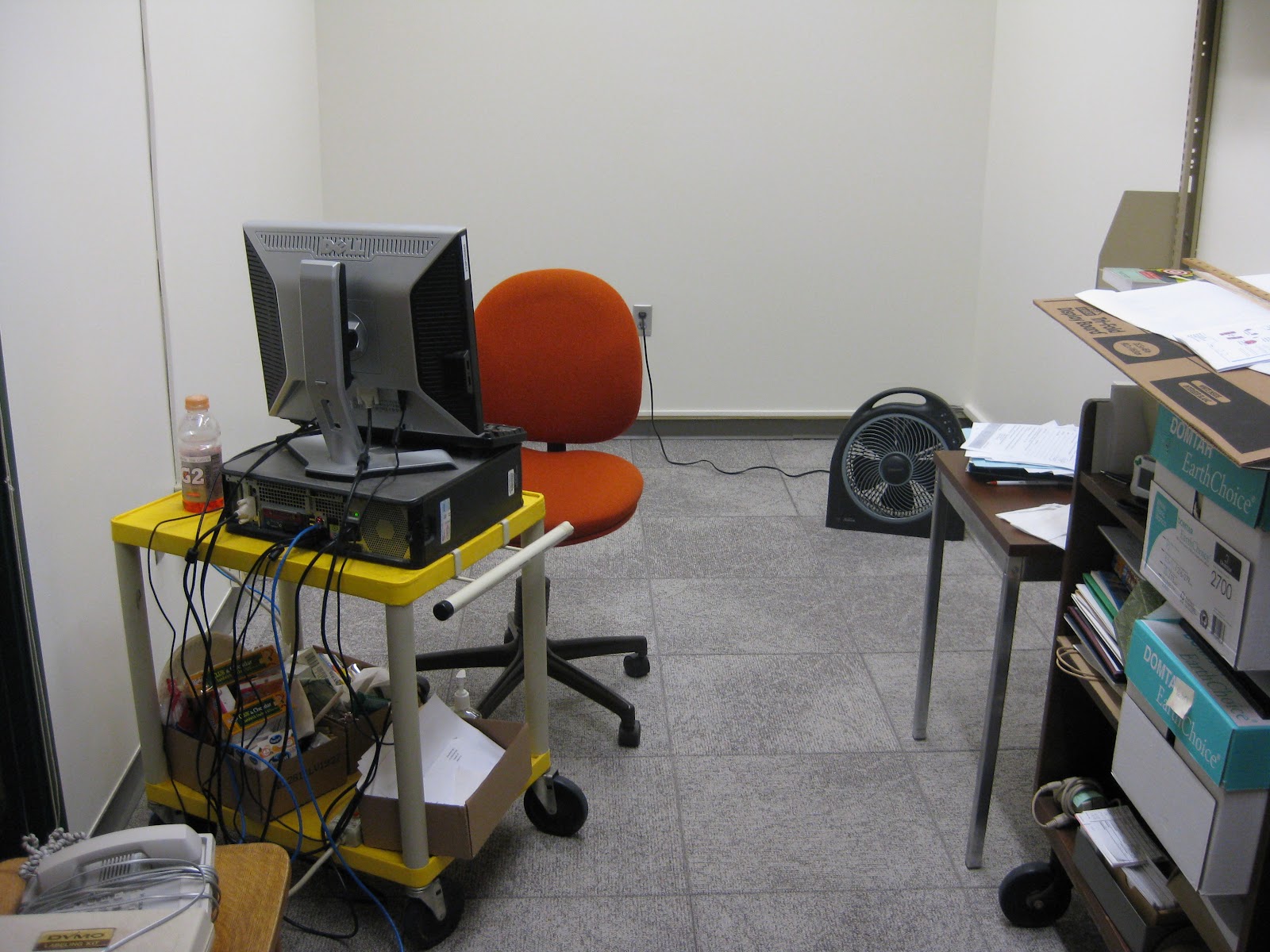
My office, for about three weeks, looked more or less like this:


But Monday the movers showed up, so I'm back to this:


Yes, I kept part of the old circulation desk for workspace and storage.  The wall to the right is all windows up to the ceiling above the shelves, and a third of it is floor to ceiling windows.  This is why my office is currently 82 degrees Fahrenheit.

Mapping out the future overall layout of the circulation area is one of the first things I did after I started in this position; we were in the planning stages with the architects at the time.  I don't know if it was similar to what they already had in mind, but the layout of the space my department occupies ended up pretty much the same as the floor plan I drew for it three years ago.

Tuesday, June 7, 2011

Melting...

So, chocolate-covered anything (like, say, Nutty Bars) is not a good idea when your building has no air conditioning.  Not if you're not fond of melty chocolate everywhere.

Anywho, the library where I work has been under construction for about two years now; they should be done at the end of August.  It's been an interesting process; the upstairs has changed the most so far, with the addition of a classroom and the realignment of the instructional technologies space.  Now it's the main floor's turn.

The changes down there (I'm temporarily located upstairs) will be immediately noticeable when you walk inside: the lobby is getting an overhaul; a wall's been removed; and the old microforms section has been deconstructed to allow for better alignment of computers.

My department's workspace is getting realigned, as well.  I had an opportunity to draw a floor plan for it, and we're getting most of what we asked for - an office for circulation/interlibrary loan staff, and more secure for our circulating equipment.  There will be a new circulation desk for the first time since the building opened; our old one was fantastically sturdy hard wood, but not really made for the computer age - nor was it ADA compliant.  My office is getting another electrical outlet (woo!).

The air conditioning was redone last summer - or at least, the chiller was.  Apparently some pumps died, so we're waiting on replacement of those to actually have cold air throughout the building.

Change can be difficult; at the same time change is (hopefully) inevitable.  I grew up in a house under continual construction; they started on it when I was three, we moved into the basement when I was four, and we moved upstairs as rooms got finished.  I'm used to the continual evolution of space.  As libraries evolve, as information resources evolve, spaces will have to keep evolving for us to continue providing consistently high-quality access.

Hopefully we'll eventually be able to do it in a consistently climate-controlled environment as our construction comes to a close, however.  I'd really like to be able to keep my emergency chocolate in my desk drawer without needing a spoon to eat it.

Tuesday, May 31, 2011

Thing 10: Future Trends

For this Thing, I read "The Future of Libraries: Interview with Thomas Frey."  I'll admit I was pleasantly surprised; most of the articles I've read on the future of libraries are doom and gloom predictions that they're an endangered species.  Mr. Frey, however, sees libraries as evolving, rather than becoming extinct.

I work in a library at one of the agriculture and technology colleges in the SUNY system.  Assuming that our campus survives to 2020 (I think we will, but you never know), and given that we are currently under renovation (my office is being moved as I write, on my laptop, in limbo), I don't know how much our building will change in nine years.  Services, to be sure, will continue to evolve.

I work in circulation and interlibrary loan.  The migration to an online world has been continual; the catalog, indices, journals, and general workflow have all moved, in whole or part, to digital formats, and as ebooks proliferate, circulation adjusts.

Monday, May 23, 2011

Thing 9: eBooks

Yeah, so, we bought a house in December... and I still don't really have room for all the books.  Not until I can afford to have custom shelving put in the dining room...

I'm one of those people who's not a fan of reading on screens.  I'm sure I'll get there eventually; as much as I love physical books, there's only so much space, and for most of what I read, the content is not format-dependent.  (In my head, I'm imagining what life would be like if I had my Betty Crocker cookbook in e-format, and an e-reader that could pull up, in parallel, the brownie recipe and the frosting recipe on the same screen...)  But, I have no e-reader, and my phone is a Windows Mobile 6.1 Treo that's two years old.

My husband, on the other hand, loves electronic books and has repurposed one of my older laptops (I'm a fan of 10" or smaller laptops for portability) as an ebook reader.  He reads a lot of pulp sci-fi, and he can get titles easily in a format that works on a variety of platforms.  He also reads on his phone, which would drive me nuts - the screen is so small!  He's getting a new Android phone in a couple months, which may or may not expand his options.

Now, all that said, I've used ebooks before.  We've had NetLibrary here at Cobleskill for quite a while, and I read Girl of the Limberlost through it... twice, actually.  I used it for research when I was doing a paper comparing the portrayal of women in Westerns with women's actual experiences in the West - Calamity Jane's short little autobiography was in there.  NetLibrary's format is cumbersome, however, especially when you compare it with our other ebook collection; the books  can't be exported from the web interface.  Our Springer ebooks are amazing - each chapter is a PDF that you can download or print.  We're allowed to do chapter "photocopies" through ILL in our license, which is great, since there are so many technical titles in that collection, and when you're buying/licensing "e" in place of print, lack of ILL license greatly curtails your service potential.  I've been using Project Gutenberg books for reference since... well, since I was an undergraduate.  (Shakespeare, King James Bible, etc.)

Sunday, May 22, 2011

Thing 8: Video

This is the first Thing that I couldn't do everything I wanted to on my work computer; the Microsoft Live Movie Maker requires Vista or later, and my work computer is still on XP.  My home desktop and my laptop are both on Windows 7, though, so I still had options.

Once the rain finally let up a bit, I was able to take my camera and wander around my back yard.  Uploading from my camera is pretty easy; it has a USB cable, and Windows will pop up an import wizard for it.

Movie Maker was easy to use for basic functions - I didn't dig into the sub menus much since it was my first time using it.  Browse for a video file, add the music file, add some words.  I minimized the movie sound so that hopefully all you hear is the music.  (It's hard to tell here since my husband has music playing in the room.)

I like the on-the-fly nature of filming from my camera; the picture isn't particularly steady when I'm walking, but if I needed to make a quick video, especially a stationary one, this is an easy route to take.


I don't know what most of the plants are since the tulips are mostly gone, and the hyacinth, as well.  There's some awesome purple and white flowers in the front of the house that I didn't get since I didn't go all the way around.  All the perennials, though, are from previous residents.  (One of our next purchases, if my husband can't fix the current one, will be a cord trimmer of some sort.  The dandelions are getting uppity.)

Tuesday, May 17, 2011

Productivity, Part 2

I want to get going with Thing 8, but I'm waiting for it to not be raining when I get home so I can take some video of my backyard.  (The house is still new-to-me, so it's all very exciting.)  I've been reading through other people's Thing 7's in the meantime, and so many people love Evernote that I decided to give it a whirl.

Well, I set it up this morning, and I've done squat with it, but I have a feeling (especially since my Outlook at home has a weird crash-bug that sometimes eats my notes in it) that it's got quite a bit of potential.

What I did learn from trying Evernote out was how to install the app on my Windows Mobile-based phone.  (It was surprisingly painless, other than having to use a micro-SD/USB adapter to get the file onto my phone in the first place.)


I subsequently learned that there is a fairly widespread error where a Windows Mobile phone can't connect to the Evernote service due to some security certificate error.  The error has been cropping up off and on for at least three years, judging by the search results in Google.

So for now, no Evernote on my phone for me (since I can't seem to log in to their website via my phone, either).  On the other hand, my phone is two years old, and Microsoft has moved on to a whole new phone operating system.  Maybe it's time to see if I'm eligible for some kind of upgrade...

Tuesday, May 10, 2011

Thing 7

I'm bad about remembering to stop and do things on the way home (my autopilot doesn't turn off easily), so I figured I would look at Remember the Milk.  Signing up was easy, and I started poking around the site.

As soon as I got to the map tab, I laughed.  This?  Quite familiar, for reasons entirely unrelated to work.  That link?  A screenshot of the log and map from World of Warcraft that tracks what quests your character is working on, how much you've completed, and where you need to go to complete them.  Knowing how well that set-up works for optimizing time use in-game (doing geographically clustered tasks at the same time), this could be quite useful, if I needed to run a bunch of errands and wanted to map them out with a checklist.  On the other hand, I'm not sure my life is complicated enough to need mapping out errands.

Further experimentation with the map quickly led me to discover that while it's Google maps, it's not.  The map itself is there, but the data is not.  You have to add any location you want to use.  While this does let you personalize the map, it also means instead of just being able to add an event in Albany, NY, you have to manually add Albany to your map to do so.

Adding recurrence to a task was also not as smooth as I expected.  I have a social event every Monday at 7 p.m.  Entering "social event every Monday at 7 p.m." however, adds a task called "social event every" on Monday at 7 p.m.  You can only use the recurrence syntax in the recurrence field after you've created the event.

Monday, May 2, 2011

Thing 6: Online Meetings

I went with option 1 for this Thing; I was browsing through the list of archived webinars and saw a bunch on Booklist's site that might be handy.

Then I made the mistake of picking "Booklist Webinar—Beads, Bulbs, and Books Bringing Home and Garden into the Library video archive" for my webinar.  That was dangerous.  Easy to download, easy to install the player - and crap, I want a bunch of those books now.

I've attended webinars and online meetings before, and this one was definitely less participatory, judging by the archived recording; since it was focused on pitching books, there didn't seem to be places for viewer questions while it was live.  As someone who still sometimes scrambles for places to find new titles, these archived webinars from Booklist could be quite useful.  (They could be useful to me live, too, if there aren't time conflicts.)

Wednesday, April 27, 2011

One more Thing (5)!

One of the things I wanted to get out of doing this series of Things was to be motivated to write on my other blog more often - so far that seems to be working!  I'm aiming for about once a week, and doing the Things and thinking about blogging and Twitter and such has been prompting me to write about other interests.

Tuesday, April 26, 2011

Thing 5

Take the weekend off?  Nope, I drew the Easter slot in the reference librarian rotation this year.  We were surprisingly busy, with actual research-related questions and not just, "Do you have a pen I can borrow?"

Feedback first so it's easy to find:
  1. The "in plain English" videos are great!
  2. It feels like there should be a more cohesive place for discussion for a program like this than in comments on blogs, but then I wonder if that wouldn't just end up being another "Thing" for people to learn.  (A forum, or a chat room, or some other group communication tool.)  Blogs can work for group communication, but it can be more cumbersome than some other media if not everyone is posting on the same one's comments.
And a summary of what I've learned (and/or observations) thus far:

Monday, April 25, 2011

OPML file #5

I've uploaded another .ompl file. cdlc4 and cdlc5 combined should have all the currently listed blogs from the Google spreadsheet whose URLs worked.

(I fixed file #4 so it really should be just the Learn with CDLC blogs and not just my whole .opml export. Apparently I clicked 'no' to save changes the other day. >.<)

Instructions for importing into Google Reader, if you're catching up and need them still.

Sunday, April 24, 2011

Barcode scanner!

I now own my very own barcode scanner! It's an Opticon my husband found for me on eBay; it looks similar to the white one here. (That's the same model; this one is refurbished though, so it's not as pretty.) I'd take a picture and post it, but I'm at work (on Easter, alas). It is basically the model we use at our Circ desk here.

I discovered when I went to start scanning books to test it that some paperbacks have a generic paperback UPC on the back cover, and an ISBN barcode on the inside front cover. For most of the books with barcodes that I tested, however, the barcode is the ISBN. I can scan straight into Excel.

Soon, goodreads, soon...

Thursday, April 21, 2011

A picture is, as they say, worth a thousand words

My folks' power is out right now (and may be through Easter), so they don't have internet or anything. (Or water - they're on a well, and no power means no well pump.) Mom called yesterday to tell me about a barn that they lost from the bad storms; I thought it was much worse than this:


The barn is about 150 years old; it was just used for hay and straw storage now, since they're getting out of the hog business. All the sows used to be kept in the pens along the east side of the building. Depending how bad the damage to the beams is, they may fix it.

Normally Mom probably would have emailed us all a picture, but without power she just called. In this case my brother sent it from his phone (he & his wife happened to be visiting). A mixture of pictures and words gets the actual state of being across much more clearly than just the phone call did.

It made me think: if you're advertising an event, on paper or on your website, or doing follow-up in a newsletter about an event, pictures can say so much for you that might not come across clearly just in the text. Or, if you have damage from natural disasters, pictures could either reassure patrons that the damage maybe isn't as bad as the news outlets made it sound, or reinforce that the library needs some help to get back to functioning as normal.

Not a new or profound concept, but "lost a barn" doesn't sound so bad now that I've seen the picture.

Tuesday, April 19, 2011

Goodreads, day 2

Hm, I deviated from my 3-5 page average yesterday and rambled on quite a bit.

I poked around goodreads a bit more since Polly friended me (thanks, Polly!), and I looked through all the friend suggestions it gave me (since now we had a friend in common). There were a lot of names I've seen from both this project and various mailing lists, which was a nice reminder that the library world has a 6-degrees-of-separation thing going on.

After looking through how the connections work, I went ahead and hooked up my Twitter account, since I can just push though status updates on books. The world will not have to suffer through an inundation of twenty-five or so years of reading. (Speaking of Twitter, after seeing the NASA pictures someone else linked for Thing 3, I added @NASA on Twitter. They're surprisingly chatty! Of course, they're in the run-up to a shuttle launch, as well.)

I added a profile picture; I didn't want to have to plug my camera in (I'm one of those people who doesn't delete pictures if they're not blurry and my camera isn't full), so I pulled the picture off my Facebook page. Facebook keeps changing how it displays pictures (now a slideshow type thing), so it took a little searching to find the "download" button. It's from last June, taken about 7:30 p.m. in front of the Lincoln Memorial with the Washington Monument behind us. The weather was awful - 90 degrees and very humid - and it reminded me of one of the reasons I'm not still living where I grew up (on the same latitude as DC). People kept offering to take pictures of us for us when they'd see us with me holding the camera out and trying to guesstimate whether we were in the shot. (My husband doesn't want pictures of him posted online, so I crop him out of stuff I post if we're both in it.)

Actually, thinking about the trip to DC reminds me that I should add The Guns of August to my books read - I got it in the bookstore in the central train station to read on the train that we were taking from our hotel in Alexandria into the center of the city. Barbara Tuchman was an amazing writer, and I wish she'd done a book on the entire war. Just getting the one August out of her left me wanting so much more.

For people still adding to RSS, here's a new .opml with all the currently added blogs. There's only been one new one since the last partial one I posted.